<html>
<head><title>Looking at Comet Hyakutake</title></head>

<body>
<h1>
Looking at Comet Hyakutake
</h1>
<h3>
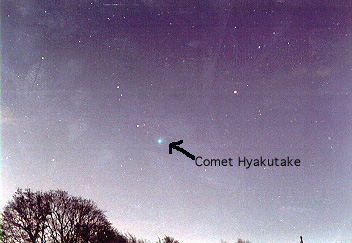
On March 22, we went outside of Houston about 30 miles to view Comet 
Hyakutake. We could see it with the naked eye and with our Galilean 
telescope. We took pictures with thirty second and one minute exposure 
times. Here is what we saw which is pretty true to what we saw with our 
naked eye.
<p><center><img src="Hyakutake.jpeg"></center>

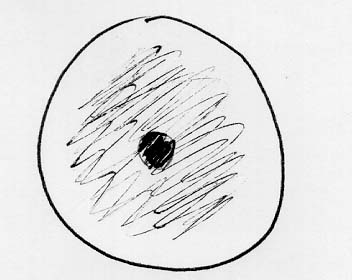
<p> Through the telescope, it was a large, fuzzy object.<p> <center> <img 
height=120 width=120 src="Hyaku.jpeg"> </center> <p>We were not able 
to see a tail with or without the telescope. However, others in darker 
sites claim they were able to see a tail. Galileo, with his refined 
observational skills, certainly used his telescopes to view the three 
comets of 1618. In his <i> Assayer</i> of 1623, Galileo argued that 
comets were merely optical phenomena.
<p> For more pictures and information about Comet Hyakutake, check out 
these other sites on the web.
<ul>
<li><a href="http://www.neurophys.wisc.edu/www/netw/hyakutake.html"> A 
variety of pictures of Comet Hyakutake </a>
<li> <a href="http://antwrp.gsfc.nasa.gov/apod/ap960314.html"> Astronomy 
Picture of the Day </a>
<li> <a href="http://www.noao.edu/noao/comets/hy/hyakutake.html"> Comet 
C/1996 B2 (Hyakutake) at NOAO</a>
<li> <a href="http://www.peak.org/%7Erickh/pages/hyakutake.html"> 
Coordinates for Comet Hyakutake </a> (Beware: This one takes a while to 
load!)

<li> <a href="http://obsv6.colorado.edu/sbo/comet/negmar19.html"> Comet 
Hyakutake's Tail</a></ul>

Would you like to learn more about comets in history? Click <a href="../../Things/comet.html">here</a> 
to go to the Galileo Project's summary of this topic. <p> Return to the <a href="./"> astronomy group 
home page</a>.


</h3>
</body>
</html>