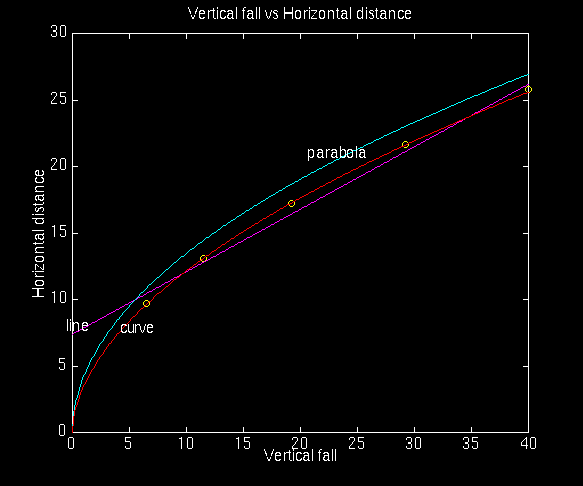
graph
of
the curves and data points
The yellow circles are the data points. The purple(ish) line is the straight line. The blue-green curve is the parabola. The red curve which intersects every data point is the "curve".
If the path of the projectile was a straight line, a straight line should fit the data best and if the path of the projectile was a parabola, an equation having the basic properties of a parabola would fit the data best.
Using linear regression, the best fits were:
y:horz dist    x:vert fall
Type graph     Equation                            Corr Coef*
straight line: y= 0.47x + 7.39                      0.9951
parabola     : y= 4.26(x^0.5)   [x=(0.235y)^2]      0.9998
curve        : y= 3.53(x^0.537) [x=(0.282y)^1.86]   0.9999
*Corr Coef = correlation coefficient : tells how closely the equation reflects the data.
I used linear regression a third time to determine exactly what type if curve would fit the data most closely. This curve is almost a parabola.
From the correlation coefficient and the graph it is obvious that the parabola fits the data much more closely than the straight line.
 Experiment
Group Home Page
Experiment
Group Home Page
written by: Sharmaine Jennings
email address:  vanese@owlnet.rice.edu
last revised: April 17, 1995